
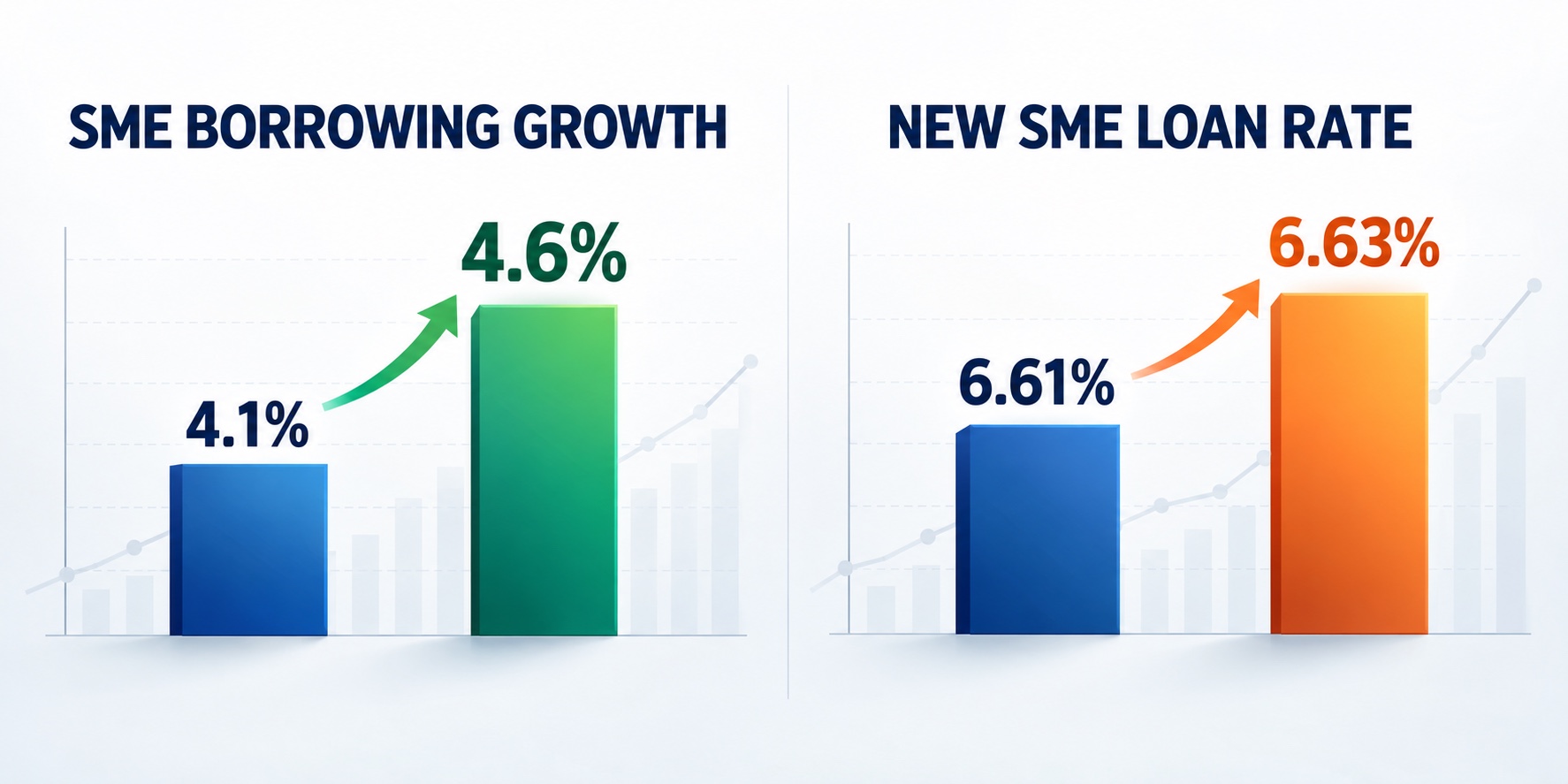
UK small and medium-sized businesses increased their borrowing in August 2026, even as the effective interest rate on new SME bank loans edged higher. The latest Bank of England figures show annual SME borrowing growth rose to 4.6%, while the effective rate on new loans reached 6.63%.
The figures were published by the Bank of England on 29 September 2026. They provide a current snapshot of borrowing through UK banks and building societies rather than a forecast or a measure of every type of business finance.
UK SME borrowing in August 2026: the key figures
- SMEs borrowed a net £0.9 billion from banks and building societies in August, unchanged from the revised July figure.
- The annual growth rate of SME borrowing increased from 4.1% in July to 4.6% in August.
- The effective interest rate on new SME bank loans increased from 6.61% to 6.63%.
- Across all UK non-financial businesses, net bank borrowing increased to £4.1 billion from £1.9 billion in July.
- Large businesses accounted for £3.2 billion of August’s net borrowing, compared with £1.0 billion in July.
These movements suggest that business borrowing remained active despite the cost of new SME lending staying above 6.6%. However, the monthly totals do not show why each business borrowed, whether applications were approved more easily, or which products individual firms selected.
What does the 6.63% SME loan rate measure?
The 6.63% figure is the effective interest rate on new loans advanced by UK resident banks to SMEs during August. It is an average across reported new lending, not the Bank Rate and not a universal price available to every borrower.
An individual business may receive a different rate depending on the amount and term requested, its trading history, affordability, sector, security and the lender’s assessment of risk. Fees and other charges may also affect the total cost of a facility.
The Bank’s underlying SME lending-rate series also notes that the movement recorded in July was mainly driven by an update to the reporting population. That caveat matters: the increase from 6.36% in June to 6.61% in July should not be interpreted entirely as a like-for-like repricing by lenders.
Borrowing growth and borrowing cost can move together
The August figures show two trends at the same time: the stock of SME borrowing grew faster over the year, while the average rate on newly arranged SME bank loans also increased slightly during the month.
This is not necessarily contradictory. Businesses borrow for different reasons, including investment, refinancing, acquisitions and working-capital requirements. A company may still decide to arrange finance when borrowing costs are elevated if the funding supports a time-sensitive commercial requirement. Equally, some firms may delay borrowing, reduce the amount requested or use existing cash instead.
The Bank of England reported that UK non-financial businesses added £6.6 billion to deposits in August after withdrawing £9.2 billion in July. That sharp month-to-month change is another reason to avoid drawing broad conclusions from a single data point.
How this relates to business loans and working-capital finance
A conventional business loan normally provides an agreed amount that is repaid over a defined period. The interest rate is only one part of the comparison: arrangement fees, repayment structure, security requirements and early-repayment terms can also affect the overall cost and flexibility.
For businesses that invoice other companies on credit terms, invoice finance uses eligible unpaid invoices as the basis for funding. Its charges are structured differently from those of a bank loan, so the Bank of England’s 6.63% average should not be treated as a direct price comparison.
Asset finance is designed around the purchase or use of equipment and vehicles. Again, the relevant costs and eligibility criteria differ from a general-purpose business loan. The latest Bank figures therefore describe one important part of the finance market, not every form of funding available to UK SMEs.
What to watch next
The Bank of England’s next Money and Credit release, covering September 2026, is scheduled for 29 October. That publication will show whether the increase in annual SME borrowing growth continued and whether the effective rate on new SME loans moved again.
For now, the clearest conclusion is limited but useful: SME bank borrowing continued to grow in August, while the average effective rate on newly advanced SME loans remained elevated and edged up to 6.63%.
Frequently asked questions
What was the effective rate on new UK SME loans in August 2026?
The Bank of England reported an effective rate of 6.63% on new SME bank loans in August 2026, up from 6.61% in July.
Did SME borrowing increase in August 2026?
SMEs borrowed £0.9 billion on a net basis during August. The annual growth rate of SME borrowing increased to 4.6% from 4.1% in July.
Does 6.63% represent the rate every SME will be offered?
No. It is an effective average across reported new SME bank lending. Actual pricing varies by borrower, lender, product, term, security and other factors.
Can the rate be compared directly with invoice finance?
No. Invoice finance commonly combines a funding charge with service or administration fees, and the facility is linked to eligible receivables. Its full cost should not be compared with a bank-loan interest rate alone.
Source: Bank of England, Money and Credit — August 2026, published 29 September 2026. This article provides general information only and does not constitute financial advice.