
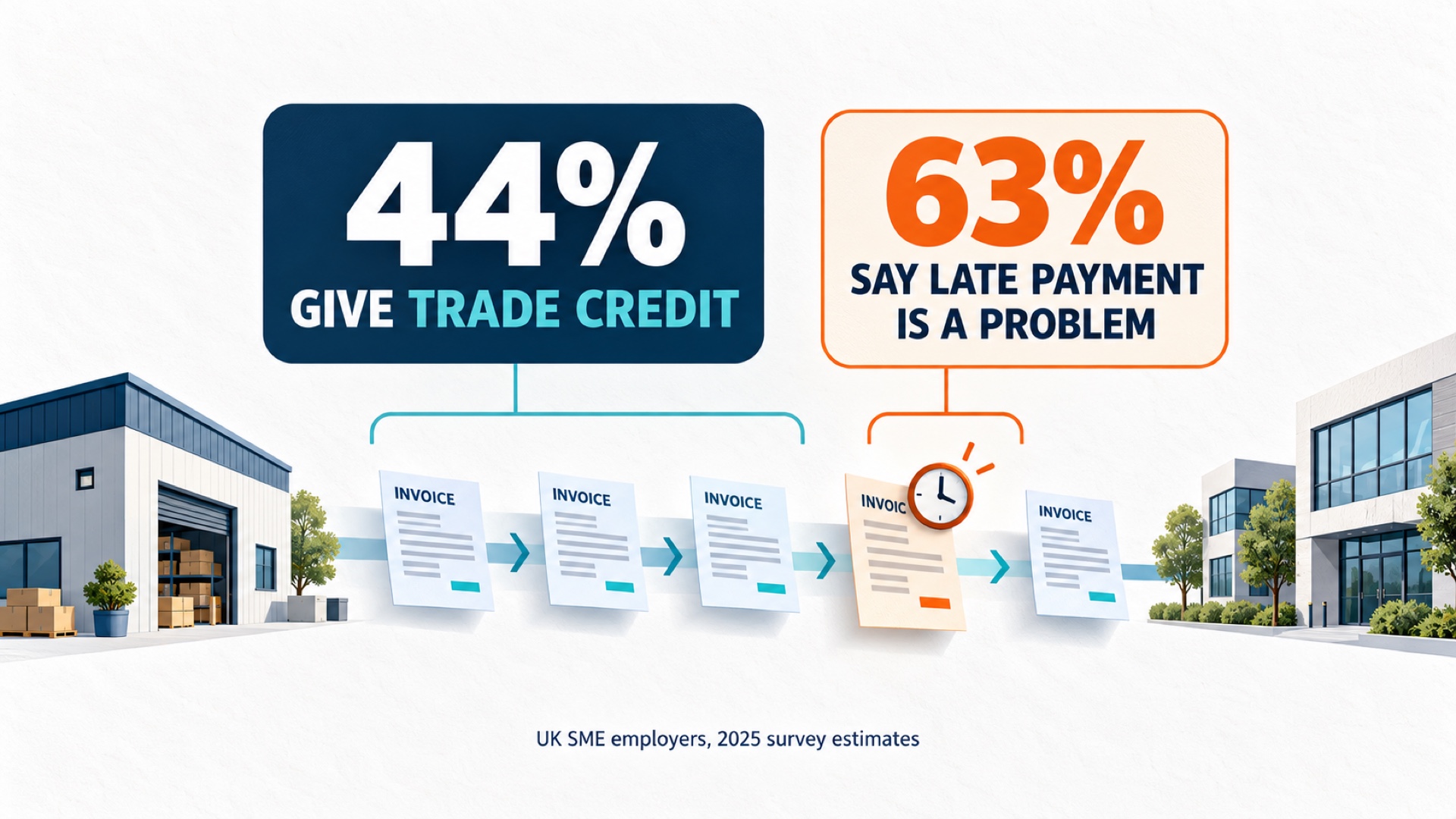
Government survey evidence published on 15 October 2026 estimates that 63% of UK SME employers offering customers trade credit regarded late payment as a problem in 2025. That was six percentage points higher than in 2024. The finding matters because businesses that sell before they are paid can face a timing gap between customer receipts and obligations such as wages, suppliers and tax.
The figure does not mean that 63% of every UK small business experienced late payment. It applies specifically to private-sector SME employers with 1 to 249 employees that gave customers trade credit. The survey estimates that 44% of SME employers offered trade credit in 2025, down from 47% in both 2024 and 2023.
What did the Small Business Survey find about late payment?
The Department for Business, Innovation, Science and Trade published the Longitudinal Small Business Survey 2025 for SME employers on 15 October 2026. Its trade-credit findings were:
- 44% of UK SME employers gave their customers trade credit in 2025;
- 63% of those offering trade credit considered late payment a problem, up from 57% in 2024; and
- the late-payment finding was equivalent to 28% of all SME employers, one percentage point higher than in 2024.
These are weighted survey estimates, not raw shares of everyone interviewed. The overall report is based on 8,022 SME employers. The trade-credit and late-payment questions were asked only of randomly assigned Cohort A, and the department applied separate cohort weights. The survey was conducted between October 2025 and April 2026, so the findings describe reported business experience in the 2025 survey period rather than payment conditions in October 2026.
Which businesses were most exposed to trade credit?
The department estimates that 80% of manufacturing SME employers offered trade credit. The equivalent estimates were 63% in information and communications, 58% in transport and storage and 55% in professional and scientific activities.
That sector pattern matters because late-payment exposure begins with the decision or commercial need to let a customer pay after goods or services have been supplied. A business that is paid immediately at the point of sale has a different working-capital profile from a manufacturer, wholesaler or business-services company carrying a substantial sales ledger.
Among SME employers that offered trade credit, late payment was most likely to be considered a problem in administration and support services, at an estimated 75%. The estimate was lowest in accommodation and food services, at 38%. These figures report businesses’ views of late payment as a problem; they do not measure the value or duration of overdue invoices.
Why can late payment affect cash flow?
When a business invoices another organisation on credit terms, revenue and cash receipt happen at different times. The supplier may need to pay staff, buy materials, meet tax liabilities or take on the next order before the customer settles the invoice.
The survey does not quantify those timing gaps. However, it is reasonable to infer that a higher reported incidence of late-payment problems can increase the importance of cash-flow forecasting, credit control and working-capital headroom for businesses that sell on account.
The practical issue is not simply whether a business is profitable. A company can record a sale and still experience a cash shortfall if the payment arrives after its own commitments fall due.
What the figures do not establish
The survey provides useful national evidence, but it does not show:
- the total value of invoices paid late;
- the average number of days by which payment was delayed;
- whether the problem was occasional or persistent for each business;
- whether late payment caused a business to borrow; or
- whether any particular finance product would have been appropriate.
It is also important to keep the population clear. The report covers UK private-sector businesses with between 1 and 249 employees. Businesses without employees and companies with 250 or more employees are outside this report’s estimates.
How does this fit with the wider SME finance picture?
The same survey estimates that 70% of SME employers used some form of external finance in 2025, down from 72% in 2024. Credit cards were the most widely used form, followed by overdrafts, leasing or hire purchase and loans from a financial institution.
Factoring or invoice discounting was used most often in manufacturing, where the estimate was 8%, and in transport and storage and administration, both at 6%. That overlap is relevant because these products use eligible unpaid business-to-business invoices as the basis for funding. It does not prove that late payment caused those businesses to use invoice finance.
A business loan normally provides an agreed amount with repayments set by the loan terms. Invoice finance instead links available funding to eligible receivables, so availability can change as the sales ledger changes. The products have different pricing, security, operational and eligibility considerations and should not be treated as interchangeable.
Questions for businesses reviewing a payment gap
Businesses assessing their working-capital position can consider:
- how much of the sales ledger is current, overdue or disputed;
- whether customer concentration could restrict funding against invoices;
- how forecast receipts compare with payroll, supplier and tax dates;
- whether a fixed loan repayment or receivables-linked facility better matches the underlying need;
- the full cost, including service charges, discount charges, minimum fees and setup costs; and
- what happens if a customer does not pay, including any recourse or bad-debt protection terms.
These questions help define the issue but do not determine suitability or approval. Provider criteria, invoice eligibility, customer quality, trading history and the terms of a proposed facility all matter.
Where invoice finance may fit
For businesses with unpaid business-to-business invoices, Compare Business Finance offers an online indicative funding estimate and an emailed indicative lender rate table. Jim, our online business finance assistant, helps gather the information needed to explore case-specific provider quotes.
An estimate is not a lender quote, and an indicative rate table is not an offer or approval. Genuine provider quotes depend on the business, its invoices, its customers and each provider’s assessment. Businesses comparing a loan, asset finance or invoice finance can also review our business funding options overview.
Frequently asked questions
Does the survey say 63% of all UK SMEs have a late-payment problem?
No. The 63% estimate applies to SME employers that gave customers trade credit. The department estimates this was equivalent to 28% of all UK SME employers. Businesses without employees were not included in this report.
What does trade credit mean?
Trade credit means supplying goods or services and allowing the customer to pay later under agreed payment terms. The supplier therefore carries the invoice until it is paid.
Does late payment automatically make invoice finance suitable?
No. Invoice finance may be relevant where a business has eligible unpaid business-to-business invoices, but suitability depends on the sales ledger, customers, provider criteria, costs and facility terms. A survey finding cannot determine the right product for an individual business.
When was the survey conducted?
Fieldwork took place between October 2025 and April 2026. The official statistics were published on 15 October 2026. The results therefore describe the 2025 survey period rather than conditions on the publication date.
Sources
- Department for Business, Innovation, Science and Trade: Longitudinal Small Business Survey 2025 — SME employers, published 15 October 2026.
- Department for Business, Innovation, Science and Trade: Small Business Survey 2025 methodology, published 15 October 2026.
This article is for general information only. It does not constitute financial, legal, tax or other professional advice. Finance availability, pricing and terms depend on the provider and the circumstances of the applicant.