
Asset finance can spread the cost of equipment, but an investment still needs to fit the business’s cash-flow timetable. A new lending release puts equipment funding back in focus. For a business considering a machine or vehicle, the useful question is not simply whether finance is being used elsewhere: it is what the proposed agreement would require before, during and after the asset starts earning its keep.
What the new figures show
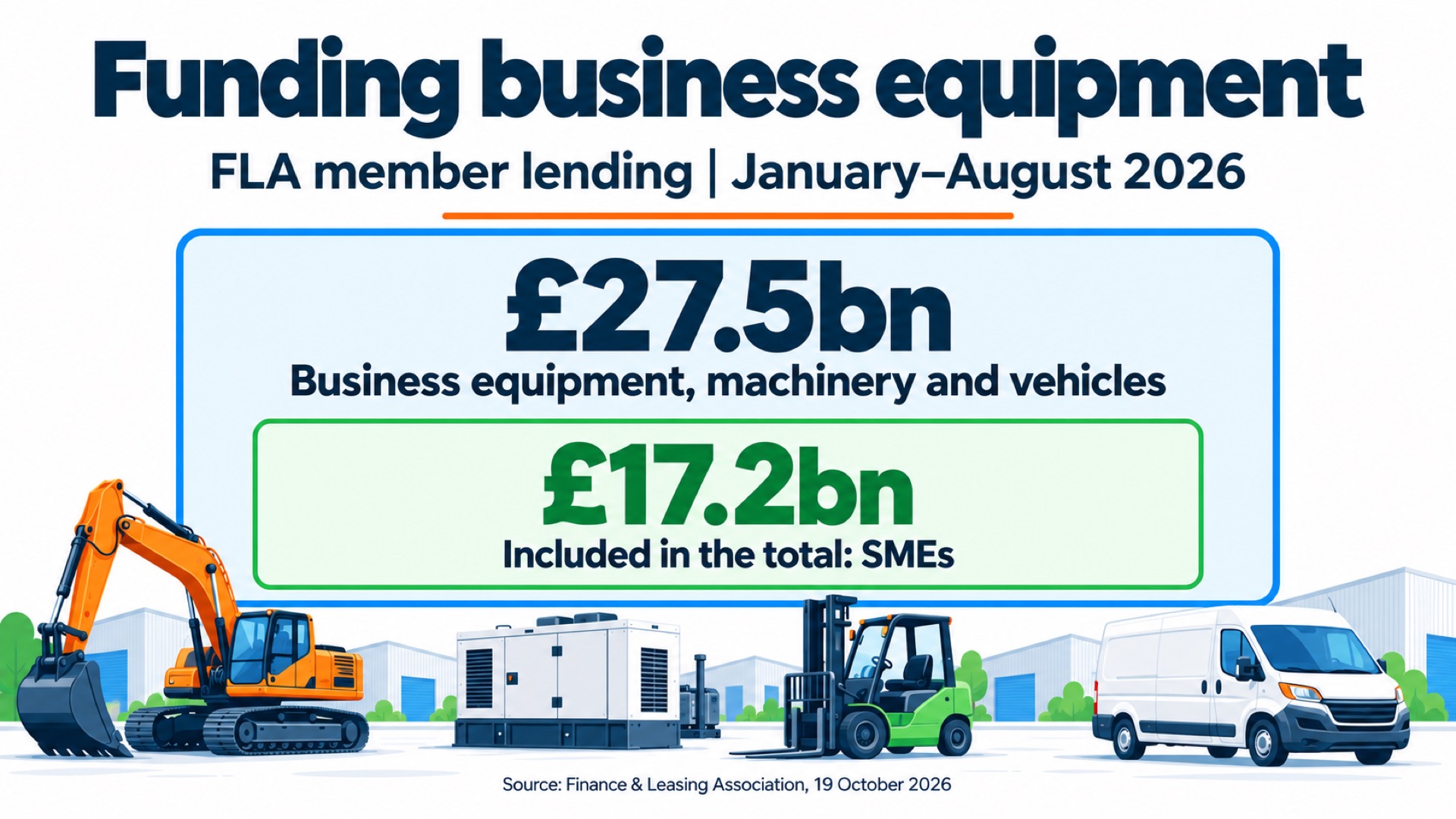
On 19 October 2026, the Finance & Leasing Association reported that its members provided £27.5 billion for business machinery, equipment and vehicles in January–August 2026, including £17.2 billion to SMEs. August business asset-finance new business was £2.965 billion, 10% above August 2025. These are reported lending values, not survey sentiment. The release does not provide an SME approval rate or a price-adjusted measure of equipment purchased. Its wider £110.8 billion headline includes household lending and must not be described as SME finance.
Why the payment timetable matters
Our interpretation: equipment funding and day-to-day working capital need to be considered together, without treating them as the same requirement.
Consider a hypothetical manufacturer replacing a machine. A funding agreement might spread the acquisition payments, but installation could still come before the first completed order. Wages, materials and other operating bills may fall due before that customer pays. This illustrates a timing question, not a forecast of savings or a real customer case.
A useful planning sheet therefore separates three dates: when money must leave the business, when the equipment becomes operational, and when receipts from its use are expected. Uncertain delivery or customer-payment dates should stay visibly uncertain. Spreading one purchase does not, by itself, establish that the remaining cash position is adequate.
Look beyond the monthly payment
The monthly amount is only one part of a proposal. A practical review can organise the details under four headings:
- Before use: deposit or initial rental, fees, delivery, installation and any payments due before commissioning.
- During use: payment dates, term, maintenance and insurance responsibilities, and any conditions affecting use of the asset.
- At the end: final payments, purchase options, return requirements and any continuing obligations.
- If plans change: early-exit provisions, guarantees, security and the consequences of missed payments.
Not every item applies to every agreement. A missing charge or unclear responsibility is a question to resolve, not a zero-cost assumption.
Ownership also needs explicit checking. HMRC’s description of hire purchase identifies an option to purchase the asset at the end of the hire period. That does not mean every lease transfers ownership. The agreement, rather than the size of its monthly payment, establishes the relevant rights and conditions. This article does not calculate tax treatment or recommend a particular structure.
Keep the asset and invoice questions separate
If the immediate requirement is equipment, the proposed asset and its intended use are central to the discussion. If the problem is waiting for customers to pay existing business-to-business invoices, that is a different funding question. Neither should be treated as an automatic substitute for the other.
Compare Business Finance explains the distinction in its invoice finance overview. Businesses considering equipment alongside an invoice-related cash gap can use that overview to clarify which requirement they want to discuss. Any indicative estimate remains separate from a case-specific provider quote, agreed terms and approval.
Does stronger lending mean my business will qualify?
No. Market activity is not an individual credit decision. The practical next step is to establish the actual asset, timing, costs and contractual requirements of the proposal being considered—not to infer eligibility from a market headline.
General information for UK business owners and directors, not a personalised funding or tax recommendation.