
UK businesses face renewed price pressure, but yesterday’s rise in inflation has not settled the next interest-rate decision. For owners planning a loan, equipment purchase or additional working capital, the practical outlook is continued uncertainty over borrowing costs alongside pressure on the cash available to repay debt.
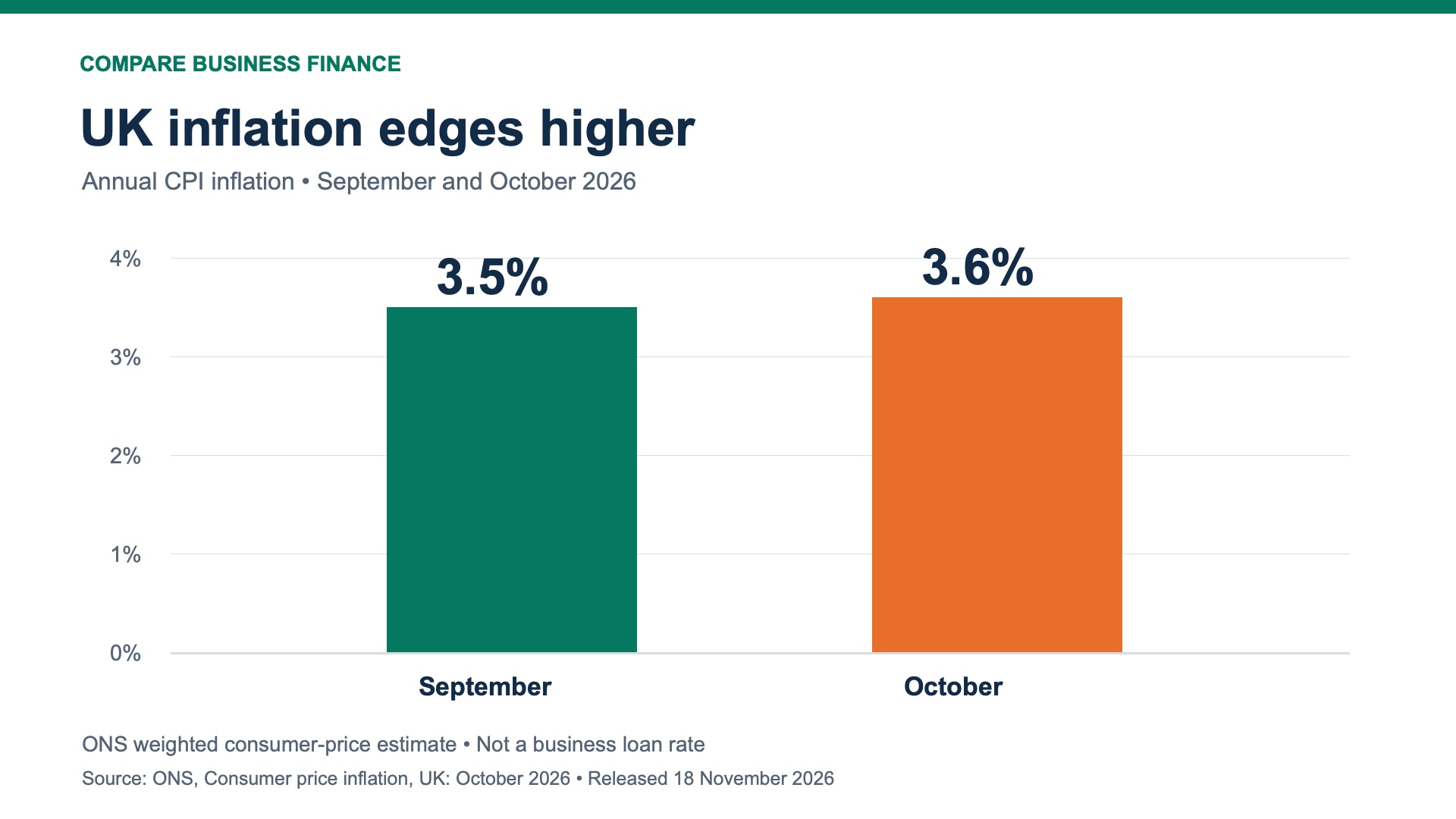
The Office for National Statistics release of 18 November 2026 estimates that annual Consumer Prices Index (CPI) inflation reached 3.6% in October, up from 3.5% in September. Motor fuels were the largest upward influence on the change. Core CPI, excluding energy, food, alcohol and tobacco, was 2.8%, while services inflation was 3.7%; both were little changed.
Does higher inflation mean another rate rise?
It keeps the risk of further tightening in view, rather than establishing a guaranteed path for rates. The Bank of England raised Bank Rate to 4% on 5 November. Its next scheduled decision is 17 December 2026.
In its November Monetary Policy Report, the Bank projected inflation of around 5% by mid-2027, largely reflecting energy pressures. That was a forecast published before the latest CPI release, conditional on the report’s assumptions, including market interest rates. It is not an observed outcome or a promise about future Bank Rate.
Speaking after the inflation release on 18 November, Governor Andrew Bailey said there was still limited evidence that energy pressures were spreading to other prices and wages. He emphasised that policy would depend on the evidence at each meeting, while warning that a longer energy shock would increase the risk of persistent inflation and the need for higher rates.
Post-release analysis leaves December’s decision open
MUFG economist Henry Cook’s analysis, published on 18 November, judged the underlying inflation detail relatively reassuring. He marginally favoured a further rate rise in February over December, citing more manageable energy prices and contained risks of wider price and wage effects. MUFG’s own tracking suggested inflation could peak nearer 4.5% if energy prices stayed around then-current levels, below the Bank’s projection of around 5%.
These are different forecasts with different assumptions, not competing measurements of what has already happened. The useful borrower takeaway is that another rise remains possible, but its timing is uncertain. The next CPI release is due on 16 December, immediately before the policy decision.
Business costs and loan affordability need to be considered together
ONS business survey results published on 19 November provide a separate view of company conditions. ONS estimates that 32% of trading businesses reported higher purchase prices in October, while 11% reported higher selling prices. These are weighted shares reporting a change, not the size of that change, and the groups are not necessarily the same businesses.
The funding implication is practical: an unchanged interest payment can become harder to cover if other bills absorb more of the cash generated by trading. The survey does not measure individual borrowers’ repayment capacity or establish that all businesses’ margins have narrowed.
For a business committed to fixed selling prices, higher supplier bills could leave less cash for debt service until contracts can be repriced. For a business able to pass on costs, the result may be different. This is a possible cash-flow mechanism, not a measured finding about either group in the survey.
Existing borrowing and new finance face different risks
For an existing fixed-rate loan, a new inflation release does not itself alter the agreed rate during its fixed period. Variable-rate borrowing depends on the contract: the reference rate, lender margin and reset arrangements matter. Business Wales guidance distinguishes fixed and variable loan terms and explains why the repayment schedule and fees need to be understood.
For new borrowing, the price offered can change before the next policy meeting. Bank Rate influences lending, but lenders also assess repayment risk and the length of the commitment, as the Bank’s interest-rate explainer describes.
The relevant questions for an owner are:
- Current debt: which facilities can reprice, on what basis, and when?
- New finance: how long is the written offer valid, and what still has to happen before funds are available?
- Affordability: can trading cash cover the commitment if input costs remain elevated and expected rate cuts do not arrive?
For invoice finance or equipment funding, ask the provider which charges or rentals are fixed and which can change. Different facilities should not be treated as sharing the same pricing mechanism.
What the evidence does not establish
CPI is a weighted estimate of changes in household consumer prices across the UK, comparing October with the same month a year earlier. It is not an index of SME costs or borrowing rates.
The business survey covers sampled private-sector industries, not every business: exclusions include agriculture, finance and insurance, and energy supply. Its frame covers UK production and Great Britain construction, retail and services. The voluntary survey ran from 2 to 15 November; 9,760 responses came from a sample of 38,519, a 25.3% response rate. Those survey totals are separate from the weighted estimates for trading businesses. The results are official statistics in development.
The borrower outlook is therefore one of continuing uncertainty over financing costs and margins. Actual facility terms and the cash available to repay them remain more useful decision inputs than assuming either an automatic rate rise or an early cut.