
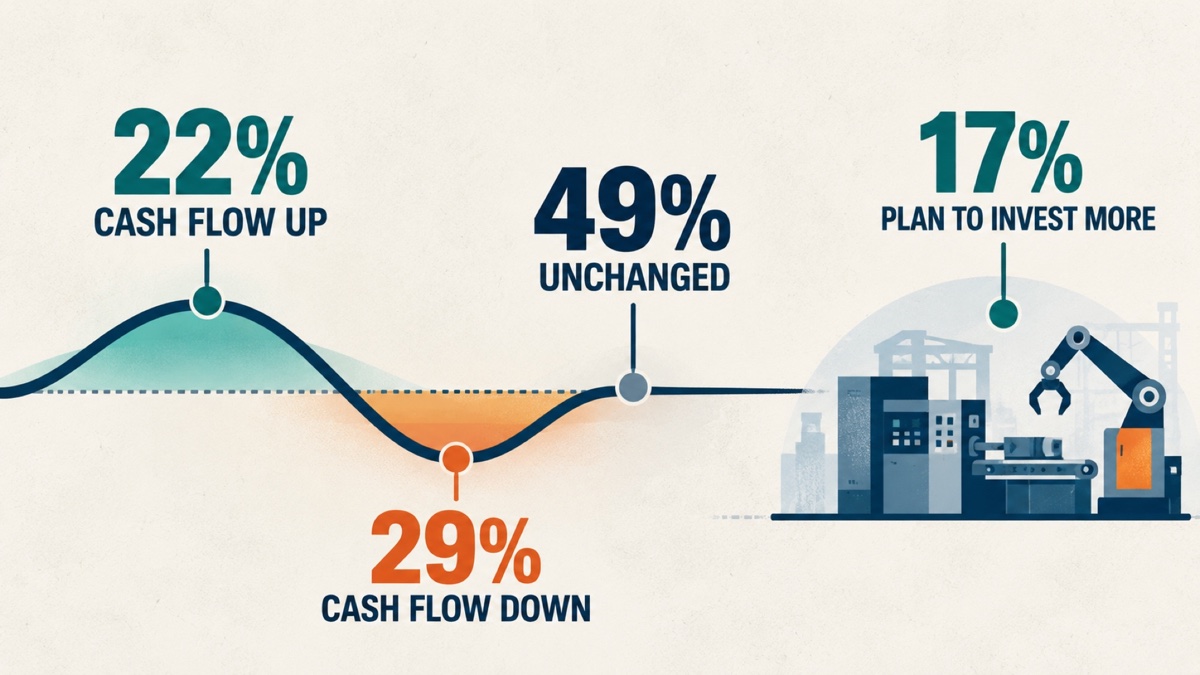
UK business surveys point to a cautious funding environment for smaller firms: cash flow remained negative overall among respondents to the latest British Chambers of Commerce survey, while lenders reported that credit availability to small and medium-sized businesses decreased in the third quarter of 2026.
The two surveys measure different things. The British Chambers of Commerce (BCC) asked businesses about their own performance and expectations. The Bank of England asked lenders how credit conditions had changed. Read together, they suggest that many smaller businesses entered the autumn with limited cash-flow momentum and subdued appetite for investment, while lenders reported less credit availability for smaller firms.
They do not show that every SME is under pressure or that business finance has become unavailable. Approval rates, lending spreads and corporate default rates were broadly unchanged in several parts of the lender survey.
What did the latest business survey report?
The BCC published its Quarterly Economic Survey findings on 7 October 2026. More than 4,300 businesses responded online between 18 August and 15 September, and 92% of respondents were SMEs.
The published percentages are shares of responding businesses, not estimates for the entire UK business population. Among respondents:
- 22% reported that cash flow had increased in the third quarter;
- 29% reported a decrease in cash flow;
- 49% said cash flow was unchanged;
- 17% planned to increase investment in plant, machinery or equipment over the following three months;
- 22% planned to reduce investment; and
- 62% expected investment to remain unchanged.
The investment percentages total 101% because the published figures are rounded. BCC described the 17% intending to increase investment as a post-pandemic low. It also said that larger firms were driving the improvement in some headline indicators, while the smallest businesses had experienced further falls in sales and cash flow.
These are reported experiences and intentions. They are not direct measurements of every business’s bank balance, borrowing requirement or future investment.
What did lenders report about SME credit?
The Bank of England published its third-quarter Credit Conditions Survey on 8 October 2026. Participating banks and building societies reported changes during the three months to the end of August, compared with the period from March to May. Responses were collected between 17 August and 4 September, so the survey does not capture later developments.
The results are weighted net percentage balances, not the percentage of lenders giving a particular answer. A positive balance indicates an increase and a negative balance a decrease. The Bank classifies a balance below -10 as a decrease and a balance between -5 and -10 as a slight decrease.
For the third quarter, lenders reported:
- a -12.1 net balance for credit availability to small businesses, classified as a decrease;
- a -10.5 balance for availability to medium-sized private non-financial companies, also classified as a decrease;
- unchanged availability for large companies;
- decreased overall demand for lending from small and medium-sized businesses; and
- unchanged corporate loan default rates across small, medium-sized and large businesses.
Lenders expected availability to decrease slightly in the following three months for both small and medium-sized firms. Those expectations are indicators of possible direction, not realised outcomes.
Does this mean business finance is becoming unavailable?
No. The surveys indicate greater caution and reduced reported availability for smaller firms, but they do not describe a market-wide withdrawal of credit.
In the lender survey, the reported proportion of small-business loan applications being approved was unchanged in the third quarter. The proportion approved for medium-sized firms decreased slightly. Lenders also reported that spreads on loans to small and medium-sized businesses were unchanged under the Bank’s classification.
The simultaneous fall in reported credit availability and demand matters. It suggests that the period was not simply one in which businesses wanted more borrowing and lenders refused it. Some firms may have delayed investment, reduced their requirements or relied on internal cash, while lenders may have become more selective. The surveys do not identify the cause for an individual business.
Why cash flow and funding structure need to be considered together
A business can have positive long-term prospects and still experience a short-term mismatch between money coming in and payments falling due. Different facilities address different commercial needs:
- Business loans provide an agreed amount with a defined repayment structure. They may be used for planned expenditure, investment or a temporary funding requirement. Our business loans guide explains the main features.
- Invoice finance links funding availability to eligible unpaid business-to-business invoices. It may be relevant where cash is tied up in the sales ledger rather than where the need is a one-off asset purchase. See our invoice finance overview.
- Asset finance is structured around vehicles, machinery or equipment. It can spread the cost of an asset over time, but the deposit, term, ownership position, total payable and any final payment need to be considered. Our asset finance guide outlines the main options.
These products are not interchangeable. A useful comparison considers the purpose and duration of the funding, expected cash inflows, total cost, security, guarantees, fees and operational requirements. Our business funding options overview brings the main structures together.
What the latest evidence means for UK SMEs
The evidence supports a measured conclusion. Responding businesses reported weak cash-flow momentum and subdued investment intentions, while lenders reported reduced credit availability and demand among smaller firms. However, approval rates, pricing measures and defaults did not deteriorate across every measure.
That makes the commercial purpose of funding especially important. Borrowing intended to cover a recurring gap may need a different structure from finance for equipment or a time-limited project. A business should compare current facility terms rather than treating survey averages or balances as an indication of what it will be offered.
For businesses with unpaid business-to-business invoices, Compare Business Finance offers an online indicative funding estimate and an emailed indicative lender rate table. Jim, our online business finance assistant, helps gather the information needed to explore case-specific provider quotes. An estimate, an indicative rate and a genuine provider quote are separate stages and should not be treated as the same thing.
Frequently asked questions
Did UK small-business cash flow improve in Q3 2026?
Cash flow remained negative overall among respondents to the BCC survey: 22% reported an increase, 29% a decrease and 49% no change. These are respondent shares from the survey, not estimates for all UK businesses.
Did lenders reduce credit availability for SMEs?
In the Bank of England survey, lenders reported decreased credit availability to both small and medium-sized businesses during the three months to the end of August 2026. The results are weighted net balances of lender responses, not the percentage of lenders reducing finance.
Were more small-business loan applications rejected?
The survey did not report a decrease in the proportion of small-business applications approved during the third quarter. It reported a slight decrease for medium-sized firms. This does not predict the result of any individual application.
Which type of business finance is suitable when cash flow is tight?
That depends on the source and duration of the requirement. Loans, invoice finance and asset finance have different repayment, security, cost and operational structures. Businesses should compare current terms against their own trading circumstances and seek professional advice where appropriate.
Sources
- British Chambers of Commerce, Quarterly Economic Survey Q3 2026 findings, published 7 October 2026.
- Bank of England, Credit Conditions Survey 2026 Q3, published 8 October 2026.
This article provides general information only and does not constitute financial, legal, tax or other professional advice. Finance availability, pricing and terms depend on the provider, product and applicant’s circumstances.